


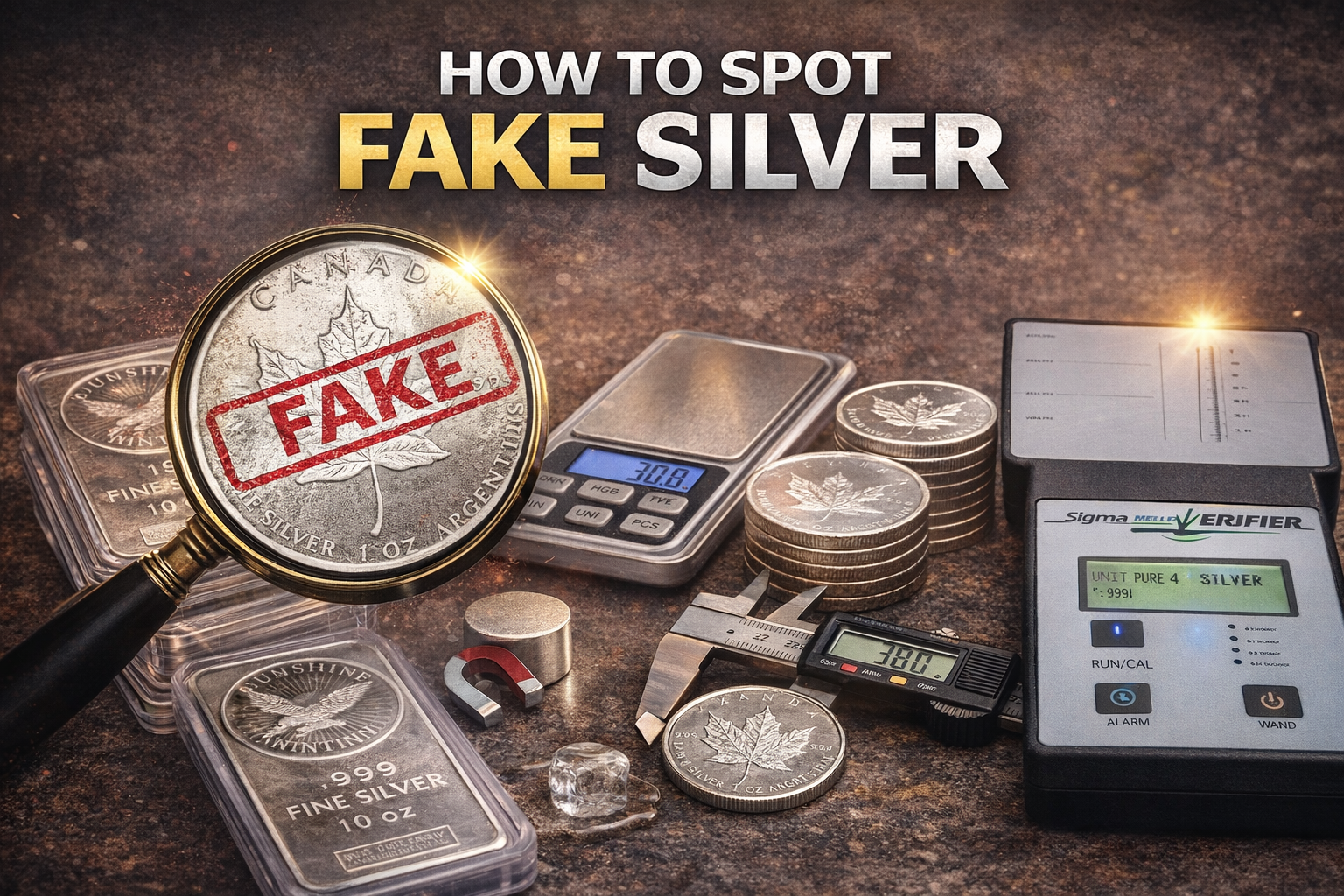
Counterfeits exist in this market and anyone telling you otherwise is not paying attention. We have seen fake bars, fake coins, and silver-plated junk come through our door from customers who bought from the wrong source and did not realize what they had until they tried to sell. It is not a huge percentage of the market but it is enough that knowing how to spot fake silver is not optional if you are serious about owning physical metals.
The good news is that most fakes are not hard to catch if you know what to look for. Silver has physical properties that are genuinely difficult to replicate perfectly and the tests are not complicated. Some you can do at home in 30 seconds. Others require equipment that a dealer will have. And the single best way to avoid fakes entirely is to buy the right products from the right places in the first place.
How to Spot Fake Silver by Eye
Learning to spot fake silver starts with your eyes before it starts with any tool. Pick up the product. Examine it closely under good light.
Legitimate bullion products from recognized mints are struck with precision. The lettering is sharp, the edges are clean, and the design holds up under close inspection in a way that fakes rarely do. Weight, purity, and the mint name should all be clearly stamped. On a Silver Maple Leaf you can see the radial lines and micro-engraved privy mark that the Royal Canadian Mint builds into every coin from 2014 onward. These security features exist specifically because counterfeiting is a real problem and the RCM took it seriously. We went deep on those features in our Silver Maple Leaf guide.
Fakes tend to give themselves away visually if you are paying attention. The lettering might be soft or the relief on the coin might be too high or too flat. Edges can look uneven or poorly finished. Sometimes the overall feel of the coin is just wrong in a way that is hard to describe but obvious when you are holding a real one in your other hand for comparison. If something looks off it probably is. Trust your eyes before you reach for any tools.
Weight and Dimensions: The Most Reliable Way to Spot Fake Silver at Home
Every legitimate bullion product has published specifications for weight, diameter, and thickness. A 1 oz Silver Maple Leaf weighs 31.1 grams and measures 38mm across and 3.29mm thick. If any of those numbers are off, even by a small amount, you are looking at a fake or a damaged product.
You need a digital scale accurate to 0.1 grams and a set of calipers. Both are cheap. The scale runs about $15 to $20 and a basic caliper is around the same. For the cost of a single ounce of silver you have the two most useful authentication tools you will ever own.
Counterfeiters face a physics problem here that most people do not think about. Silver has a specific density. If they use a lighter metal like aluminum or copper to fake a silver bar, the weight will be wrong for the dimensions. If they use a heavier metal like lead or tungsten to get the weight right, the dimensions will be off. Getting both weight and dimensions to match a genuine product using a different metal is extremely difficult. That is why this test catches most fakes and it is why we consider it the most important one you can do at home.
The Magnet Test
Silver is not magnetic. If you hold a strong magnet up to a bar or coin and it sticks, it is not silver. That is the easy version.
But there is a more useful version of this test. Get a neodymium magnet, the rare earth kind that you can buy online for a few dollars, and hold your silver at a 45 degree angle. Slide the magnet down the surface. On real silver the magnet will slide slowly, almost like it is moving through something thick. That is because silver is diamagnetic. It creates a weak opposing field that slows the magnet without attracting it. The magnet slide test is one of the faster ways to spot fake silver without any specialized equipment.
On a fake made from a non-silver metal the magnet will either stick, slide off quickly with no resistance, or behave completely differently. This test is fast, non-destructive, and surprisingly effective for a first pass.
The limitation is that it only tests the surface. A bar with a lead or tungsten core and a thick silver plating could pass the magnet test on the outside. That is where weight and dimensions come in as a secondary check.
The Ping Test
Silver has a distinctive sound when struck. A clear high-pitched ring that sustains for a second or two. Tap a real silver coin on your fingernail or gently strike it against another coin and you will hear it. It is a clean bright tone that most people recognize once they have heard it a few times.
Fakes made from base metals produce a duller, shorter sound. The ring does not sustain. It sounds flat. With a bit of practice the ping test becomes another reliable way to spot fake silver, especially on coins.
This test works best on coins and small bars. On larger bars the sound can vary depending on size and where you strike it so it is less reliable as a standalone check. But combined with weight and the magnet test it adds another layer of confidence.
The Ice Test and Why We Do Not Love It
You will see this one recommended everywhere. Put an ice cube on your silver and if it melts fast the silver is real because silver has the highest thermal conductivity of any metal.
The concept is sound but in practice the test is unreliable. Room temperature, how long you have been holding the silver, ambient humidity, and the size of the ice cube all affect the result. Copper also conducts heat well and will melt ice noticeably fast. So a copper fake could pass this test while a cold silver bar sitting in a basement could appear to fail it.
We would not rely on this one by itself. If you want to try it for fun go ahead but do not use it as your primary authentication method.
What Dealers Use
When we need to verify a product we use professional tools that give definitive answers.
The Sigma Metalytics tester is what most serious bullion dealers and coin shops rely on for day-to-day verification. It sends electromagnetic waves through the metal and compares the reading against stored signatures for different metals and purity levels. Takes a few seconds, works on coins and bars of various sizes, and does not damage the product. For a dealer handling hundreds of pieces it is indispensable.
XRF analyzers go even further. They use X-ray fluorescence to identify the exact composition of the metal including all trace elements and they can detect layered fakes where the surface is one metal and the core is another. The machines are expensive though, typically $15,000 and up, which puts them out of reach for home use. But any reputable dealer should have one or have access to one through their network.
If you are ever unsure about something you own, bring it to us or to any established dealer and ask them to test it. A quick verification takes seconds and it is far better than guessing.
The Easiest Way to Avoid Fake Silver Entirely
This is the part that matters more than any test. The best way to spot fake silver is to never encounter it.
Buy from established dealers who source directly from recognized mints and you eliminate the problem before it starts. Every product we sell comes from the Royal Canadian Mint, Sunshine Minting, Asahi, Silvertowne, or other accredited refiners. The chain of custody is direct and verifiable. When you buy from us you know where the product came from because we know where it came from.
The places where fakes circulate most are peer-to-peer platforms. Kijiji, Facebook Marketplace, eBay. The price might look attractive but these are the channels where we see the most problems. Customers come in with products they bought from private sellers and the metal turns out to be plated copper or worse. Until you have the tools and experience to verify on your own, these platforms are not worth the risk for bullion purchases.
Government minted coins with built-in security features are your best protection on the product side. The Maple Leaf and the American Eagle both have anti-counterfeiting technology that generic rounds and bars do not. The Maple Leaf’s radial lines, micro-engraving, and Bullion DNA program make it one of the hardest silver coins in the world to fake convincingly. That is part of why we recommend it as a first purchase for people just getting into silver.
And if a deal seems too good to be true it is. Nobody is selling silver significantly below what every other dealer is charging unless something is wrong with the product.
What to Do If You Think You Have a Fake
Do not panic. Bring it to a dealer for testing before you assume the worst. Sometimes a coin just looks different because of wear, toning, or a different year’s design. Not every odd-looking piece is counterfeit.
If it does turn out to be fake, document everything. Where you bought it, when, how much you paid, and any communication with the seller. If the seller is a business, report them. If it was a private sale you may have limited recourse but the documentation still matters.
And use it as a lesson. Going forward stick with recognized products from established dealers. That is the simplest and most effective way to protect yourself. We wrote about why product choice matters for resale and verification in our posts on precious metal purity and silver bars vs silver coins.
If you want to start with products that are easy to verify and universally recognized, browse our silver coins and silver bars. Everything we carry is sourced directly from accredited mints and ships insured across Canada.


Leave a Reply