


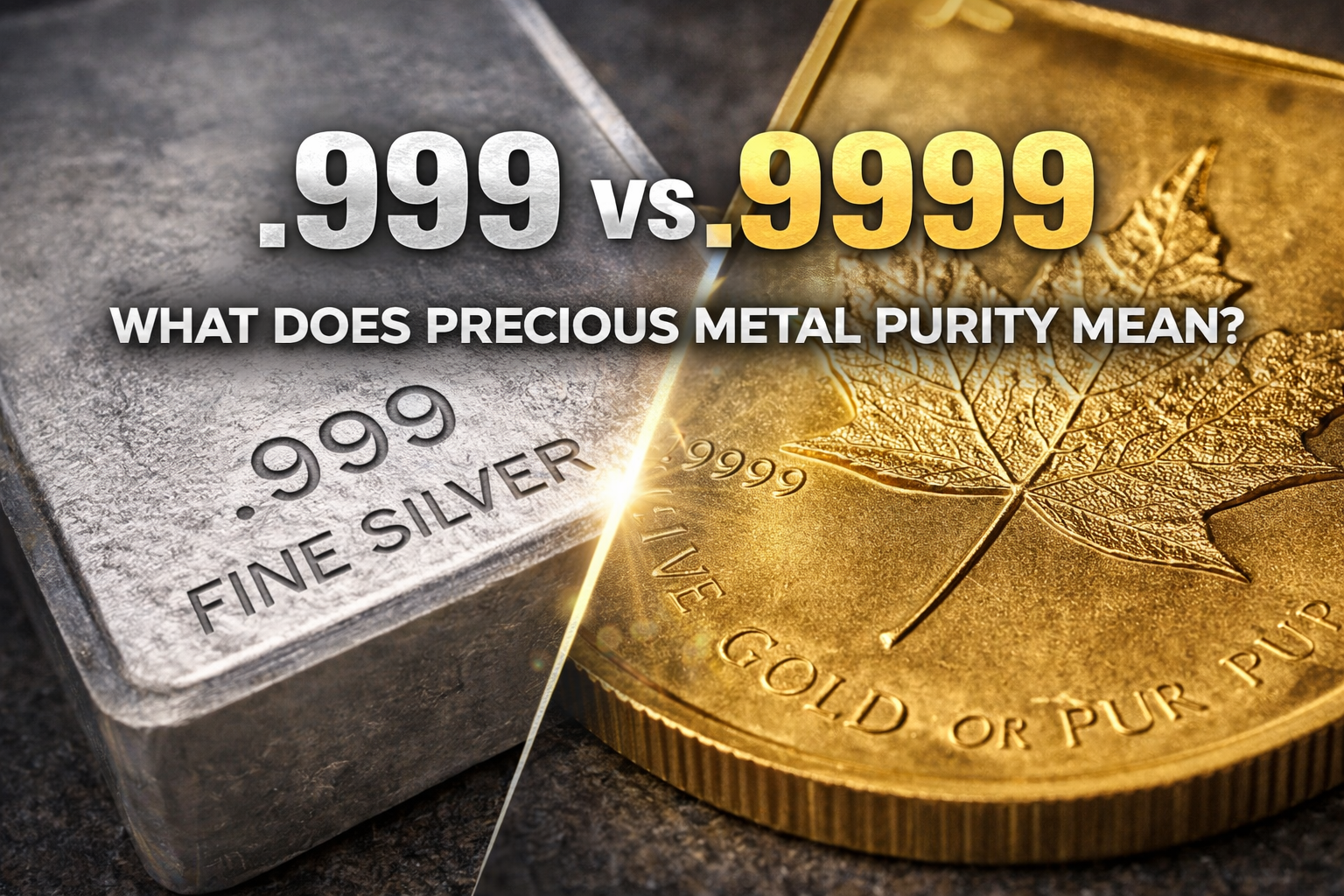
If you have ever looked at a silver bar or gold coin and wondered what .999 or .9999 means, you are not alone. We get asked about precious metal purity constantly. And most of the explanations out there make it more complicated than it needs to be.
So here is what those numbers mean, why they matter when you buy and sell, and how to make sure what you are holding is the real thing.
What the Numbers Tell You
The numbers stamped on a bar or coin represent how pure the metal is. It is expressed as a decimal out of 1.000, which would be theoretically perfect precious metal purity. Nobody actually produces 1.000 because it is not possible to remove every single trace of other elements.
For silver, the two standards you will see on bullion products are .999 and .9999. A .999 silver bar is 99.9% pure silver. A .9999 silver coin like the Canadian Silver Maple Leaf is 99.99% pure. The difference is one hundredth of a percent. Tiny. But it is there and it tells you something about the level of refining that went into the product.
For gold, you will see the same fineness system on bullion. A 1 oz Gold Maple Leaf is .9999 fine. A 1 oz RCM gold bar is also .9999 fine. You might also see gold described in karats, especially in jewelry. 24 karat is the purest at 99.9% or higher. 22 karat is 91.7%. 18 karat is 75%. But for investment bullion in Canada you are almost always dealing with .999 or .9999 fineness, not karats.
Does Purity Change What Your Silver or Gold Is Worth
Here is where people get confused. A 1 oz .999 silver bar and a 1 oz .9999 silver coin both contain exactly one troy ounce of pure silver. The .999 product is just slightly heavier overall because the remaining 0.1% is other metal that makes up the total weight. But the silver content is the same. One troy ounce.
So at melt value, they are identical. The spot price applies the same way to both. Where things start to differ is in the premium and the resale.
A .9999 coin from a sovereign mint like the Royal Canadian Mint carries a higher premium than a .999 generic bar. Part of that is the government backing and security features. Part of it is the purity itself. Getting to .9999 requires additional refining steps beyond what most private mints bother with. It is a higher standard of production and the RCM is one of the few mints in the world that does it on their standard bullion coins. That level of refining is one of the things that sets the Maple Leaf apart from coins like the American Silver Eagle, which is struck at .999.
When you go to sell, that distinction plays out in what you get back. Recognized government coins with .9999 purity tend to recover more of their premium than generic .999 bars and rounds. Not because the extra nine changes the melt value. Because the product itself is more in demand and easier for dealers to move.
Why Precious Metal Purity Matters for Tax Exemption in Canada
This is the part most people do not think about until checkout. In Canada, investment grade precious metals are exempt from GST and HST. But there is a purity threshold you have to meet.
For silver, the product needs to be .999 fine or higher. For gold, it is .995 fine or higher. The product also needs to be in the form of a bar, coin, ingot, or wafer. Every product on our site meets these requirements so there is no tax at checkout. In Ontario that is a 13% savings. On a $2,000 order that is $260 you are keeping.
But if you are buying from somewhere else, especially a private seller, you need to verify that what you are getting actually meets the purity threshold. If it does not, you could be on the hook for sales tax and the product may not be considered investment grade. This is one more reason why buying from a dealer who carries products from recognized mints matters.
How Precious Metal Purity Affects What You Should Buy
For most buyers the practical question is simple. Should you care about .999 vs .9999 when deciding what to buy.
If you are stacking silver for weight and you want the lowest premium per ounce, .999 silver bars from reputable mints like Sunshine Minting or Asahi are a great option. They are investment grade, tax exempt, and they sell back easily. The .999 purity does not hold you back in any meaningful way.
If you want the highest purity available, the best security features, and the easiest resale experience, .9999 coins like the Silver Maple Leaf or the Gold Maple Leaf are the standard. We wrote a full post on why we recommend the Silver Maple Leaf as a first purchase and purity is a real part of that.
If you are choosing between bars and coins more broadly, our post on silver bars vs silver coins goes deeper into the premium, resale, and storage tradeoffs.
Either way, anything .999 or above is investment grade. You are in good territory with both.
How to Verify What You Own
This matters more than most people think. Counterfeits do exist and if you are buying from anyone other than an established dealer you should know how to check what you are getting.
The easiest first step is to look at the markings. Legitimate bullion products are stamped with the purity, weight, mint name, and usually a serial number or year. If any of that is missing or looks off, that is a red flag.
Weight and dimensions are the next check. A real 1 oz Silver Maple Leaf weighs 31.1 grams and measures 38mm in diameter. If it is light or the dimensions are wrong, something is not right. A decent kitchen scale and a caliper can catch a lot of fakes.
Sound is another one. Silver has a distinct ring when you tap it. Experienced buyers can tell pretty quickly by sound alone whether something is real or not. It takes practice but it is a useful skill to develop.
For anything beyond basic checks, professional testing is the way to go. Dealers use tools like XRF analyzers and Sigma Metalytics testers that can verify purity without damaging the product. If you are ever unsure about something you own, bring it in. We test products for customers regularly and it takes a few seconds.
The Maple Leaf makes verification easier than most coins because of its built-in security features. Radial lines, micro-engraved privy marks, and the Bullion DNA program all give you additional ways to confirm authenticity beyond just weight and dimensions. We covered all of that in detail in our Silver Maple Leaf guide.
What to Watch Out For
A few things we see come up repeatedly.
Products with no mint markings or vague stamps. If it does not clearly state who made it and what the purity is, be cautious. Reputable mints put their name on their products because their reputation depends on it.
Deals that seem too good to be true. If someone is selling silver well below what any dealer is offering, there is usually a reason. Either the product is fake or it is stolen. Neither is a situation you want to be in.
Buying from unverified sellers online. Kijiji, Facebook Marketplace, random websites. We have seen customers come in with products from these sources that turned out to be plated tungsten or copper cores with silver coating. It happens more than people think. Stick with established dealers who source directly from the mints.
And if you are ever unsure about something you are considering buying, reach out to us before you commit. A quick conversation can save you from an expensive mistake.
Understanding Precious Metal Purity Is Part of Buying Smart
You do not need to become a metallurgist to buy silver or gold. But understanding what the numbers mean, how purity affects your tax status and resale, and how to verify what you own puts you in a much stronger position than most buyers.
The short version. Anything .999 or above is investment grade. The Royal Canadian Mint goes to .9999 because they can and it matters for the quality and recognition of the product. Both purity levels are tax exempt in Canada. And the best way to protect yourself is to buy recognized products from reputable dealers.
If you are ready to start, browse our silver coins, silver bars, gold coins, and gold bars. And if you want to understand more about the products themselves, our Silver Insights section covers the rest.


Leave a Reply