


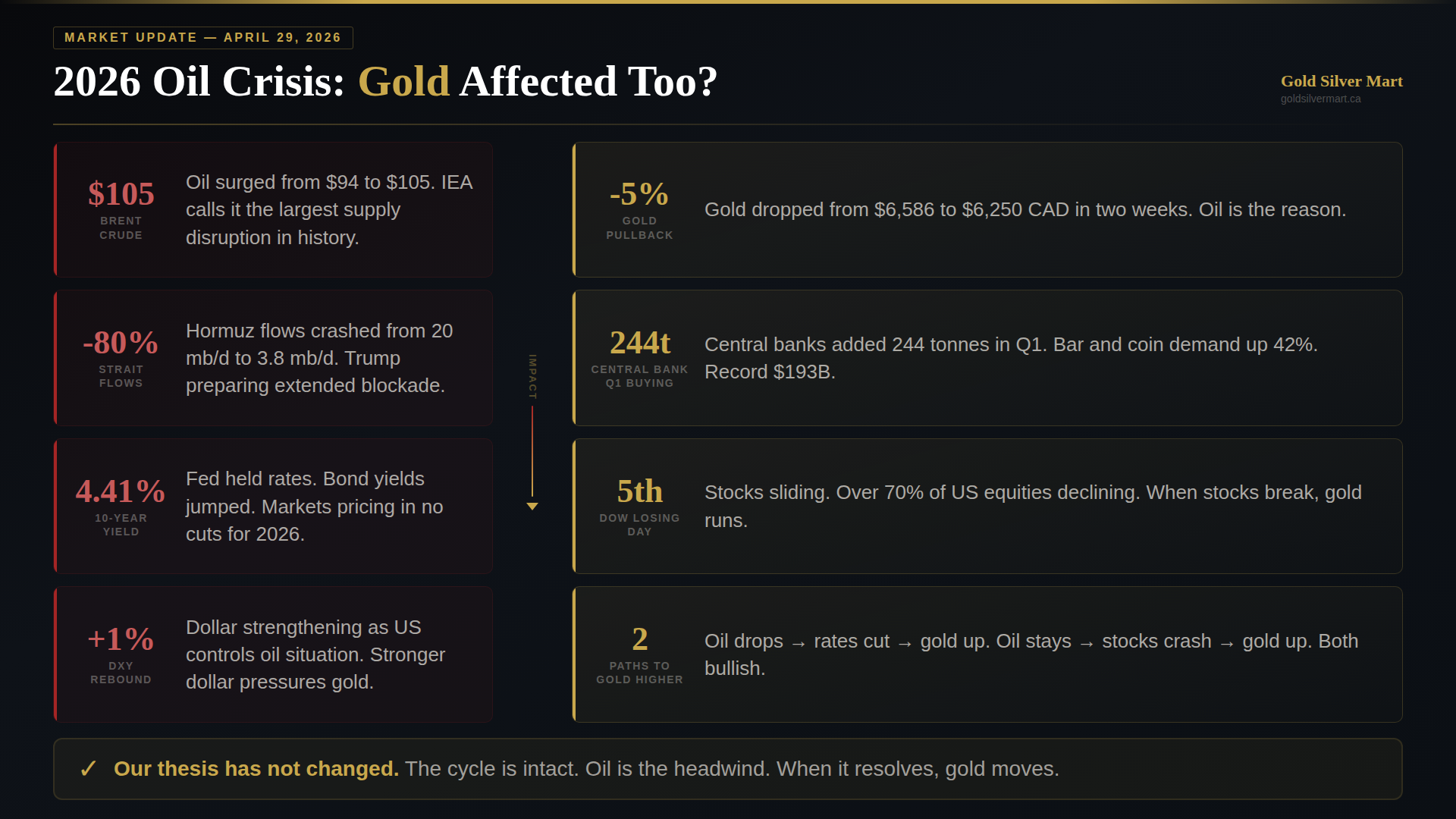
Two weeks ago we published a post saying we think now is a good time to buy gold. Gold was sitting at $6,586 CAD. Since then it has dropped to around $6,250 CAD. About 5% lower. The 2026 oil crisis is the reason.
We are not going to pretend that did not happen. It did.
If you are trying to understand the relationship between the 2026 oil crisis and gold, you are watching it play out in real time right now. Oil is the single most important variable in the gold market at this moment and understanding how the two connect is the difference between panicking at the wrong time and seeing the setup for what it is.
The 2026 Oil Crisis: Where We Are Right Now
When we wrote the last article, Brent crude was at $94. We said oil would likely continue to come down as the war situation stabilized. It did the opposite. Brent is now above $105. WTI is at $99. The 2026 oil crisis is now the largest supply disruption in the history of the global oil market according to the IEA.
Strait of Hormuz flows dropped from 20 million barrels per day before the war to 3.8 million barrels per day. That is an 80% collapse in the most important oil transit route on the planet. The IEA head said April would be worse than March because the ships that were already in transit before the war have now all arrived at their destinations. There is nothing new coming through.
Trump’s Extended Blockade
Today Trump rejected Iran’s proposal to reopen the strait. The Wall Street Journal reported he told aides to prepare for an extended blockade. This is not resolving quickly. The ceasefire announced on April 8 has not restored shipping traffic. The strait is economically closed even if it is not physically sealed.
UAE Leaves OPEC
Yesterday the UAE announced they are leaving OPEC as of May 1. After six decades. Trump reportedly sees this as a positive because it frees the UAE to produce more oil independently without OPEC quotas. Whether that actually adds meaningful supply anytime soon is a different question but the signal is clear. The old oil order is shifting.
OPEC+ added 206,000 barrels per day in April. Saudi Arabia led the increase. But when you have lost 10.1 million barrels per day of global supply according to the IEA’s March data, adding 206,000 is a rounding error. The math does not work. Supply is nowhere near replacing what was lost.
What the Forecasters Are Saying
The EIA forecast on April 7 projected Brent peaking at $115 per barrel in Q2 before easing below $90 by Q4 and averaging $76 in 2027. The IEA’s April 14 report assumed supply chains would start normalizing from May. Both of those forecasts were made before Trump rejected Iran’s proposal today and before the UAE announced its exit from OPEC yesterday. The next IEA report drops May 13 and the next EIA report May 12. Those will be the first to reflect the current reality. If they revise upward, which seems likely given what happened this week, the oil headwind on gold stays in place longer. If they hold their base case of oil coming down in the second half of the year, that is when the gold thesis kicks back in. Oil below $90 plus central banks cutting rates is the setup we have been writing about since the beginning. We are just not there yet.
How the 2026 Oil Crisis Is Hitting Gold
Higher oil pushes inflation higher. With higher inflation forces central banks to keep rates elevated or risk losing credibility. Higher rates make bonds and cash more attractive relative to gold which pays no yield. Money flows out of gold and into yield-bearing assets.
The Fed held rates at 3.5% to 3.75% today. As expected. The 10-year Treasury yield jumped to 4.41% after the decision. The market is now pricing in the possibility that central banks may not cut at all this year and could even tighten further if oil keeps climbing. That is the worst short-term environment for gold. Rising rates and a strengthening dollar at the same time.
The DXY has rebounded about 1% over the last couple of weeks. The dollar is strengthening because the US is in a relatively stronger position than other economies right now. Trump’s blockade strategy, whatever you think of the politics, has put America on the controlling side of the oil situation. Other countries, especially in Asia, are scrambling for supply. The US has its own production. That relative strength shows up in the dollar and a stronger dollar pushes gold down because gold is priced in dollars globally.
So oil is up. Rates are holding or going higher. The dollar is up. All three of those hit gold at the same time. That is why gold is at one-month lows even though the geopolitical situation is arguably worse than it was two weeks ago.
The 2026 Oil Crisis Creates Two Paths and Both End With Gold Higher
This is why we think gold is a safe bet either way right now. If oil comes down, inflation eases, central banks cut rates, and gold gets the tailwind back. If oil stays elevated or goes higher, it crushes the economy, stocks slide, and people have nowhere to go but gold. Gold is the hedge in both directions. The only scenario where gold stays under pressure is if oil stays high and the dollar keeps strengthening at the same time without stocks breaking. That is what is happening right now but it is not sustainable. Something gives. Either oil comes down or stocks come down. Both outcomes are bullish for gold on different timelines.
Stocks are already starting to feel the pressure. The Dow just posted its fifth straight losing day. The S&P is flat but the breadth is ugly. Over 70% of US equities were in decline today. The Russell 2000 dropped over 1%.
If oil stays above $100 for another few weeks the damage to equities accelerates. And when stocks slide, that is historically when gold finds its bid. We have been writing about this pattern since our post on why we think the commodity cycle has years to run. Oil spikes create economic pain. Economic pain eventually forces central banks to ease. Easing is bullish for gold. The question is timing and we are honest about the fact that we cannot time the exact bottom.
What Central Banks Are Doing Should Tell You Something
While retail investors are watching gold drop and getting nervous, central banks are buying. Aggressively.
In Q1 of 2026, central banks added 244 tonnes of gold to their reserves. That is up 3% year over year. Bar and coin investment globally was up 42% to 474 tonnes, the second highest quarter on record. Total Q1 gold demand hit a record $193 billion in value.
Poland added 20 tonnes in a single month and has built its reserves to 570 tonnes. They are targeting 700 tonnes. Emerging markets across the board are diversifying into gold.
These are institutions with data sets and analysis capabilities that retail investors do not have access to. They see economic projections, geopolitical risk assessments, and fiscal trajectories that are not public. And they are buying gold at these prices. Not selling. Buying. That is worth thinking about when you are watching the price tick down on your screen and wondering if you should panic.
Why the 2026 Oil Crisis Has Not Changed Our Thesis
Gold dropped 5% since our last article. Oil went the wrong direction. We said it would come down and it went up. We need to own that.
But our thesis was never about the next two weeks. It was about a multi-year commodity cycle. And that thesis has not changed because of a two-week oil spike. The global economy is still slowing. Canada’s GDP contracted in Q4. Unemployment is at 6.7%. The macro forces we have been writing about, massive government debt, weakening consumer confidence, central banks that want to cut but cannot yet, those are all still in play. Oil is the variable that is keeping everything frozen right now. When it moves, everything else moves with it.
What We Are Watching
We are not telling anyone to rush in tomorrow. Timing the market to the day is the challenge and we have never pretended otherwise. The overall trend is what we are trying to help guide with.
Here is what would give us more confidence. If gold can hold these levels and start posting positive days while either stocks are dropping or oil is pulling back, that would be a signal that the bottom is in. Right now everything is correlated in the wrong direction for gold. Oil up, dollar up, gold down. When one of those variables breaks, gold will move. The 2026 oil crisis gold relationship is the most important dynamic in the market right now and it will resolve one way or another.
If you are bold, these prices around $6,250 CAD are better than the $6,586 you would have paid two weeks ago. You are getting gold at a 5% discount to where it was when we said buy. The macro has not changed. The cycle has not ended. What changed is oil and by extension rates and the dollar.
If you are more cautious, there is nothing wrong with waiting and watching. See how the next few weeks play out. See if oil starts to come down or if stocks start to crack. Either one would be a catalyst for gold.
We wrote about physical gold vs paper gold and why we only sell physical. We wrote about why physical gold is the only asset AI cannot hack. If anything the instability from the 2026 oil crisis reinforces why owning something physical that exists outside the financial system matters.
Check the live gold price in CAD. Browse our gold coins and gold bars. When you are ready to sell, we buy it back at competitive rates. And if you want to talk through what makes sense for your situation right now, we are in Toronto.


Leave a Reply