


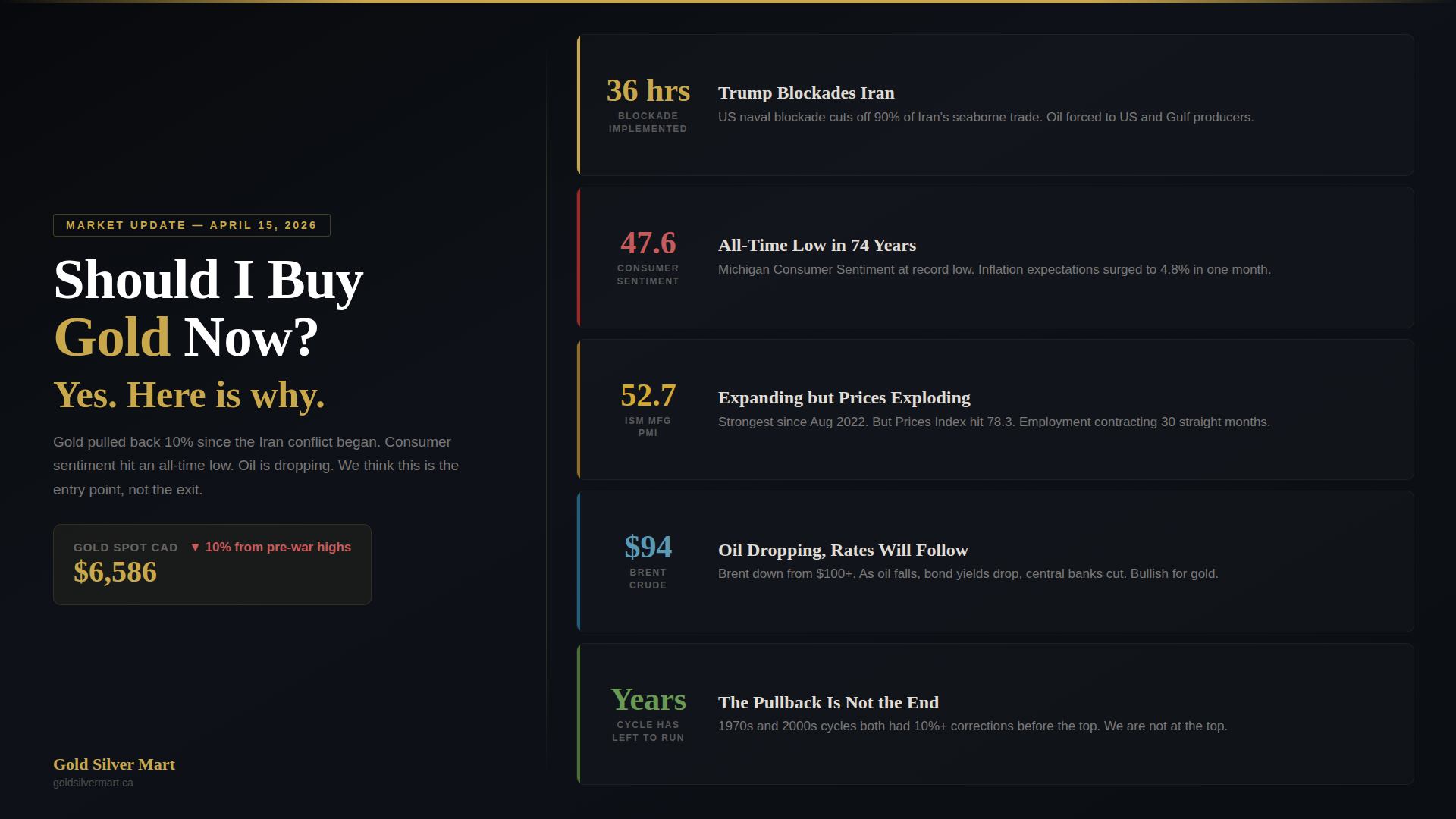
Someone messaged us this week and asked a simple question. How’s Gold. Buy or sell. We get versions of this every day but this one came at an interesting moment. Gold just pulled back about 10% since the Iran conflict began. Oil is dropping. The US just made a major strategic move in the Strait of Hormuz. The whole picture shifted in the last few days and it is worth walking through what we think is happening and why we still think the answer to should I buy gold now is yes.
Gold is sitting around $6,586 CAD per ounce as of April 15, 2026. A lot of people look at that pullback and get nervous. We look at it and see a better entry point into a cycle that we believe still has years to run.
What Trump Just Did
Trump flipped the Strait of Hormuz situation in a way that most people have not fully processed yet.
Since the war started in late February, Iran had been controlling the strait. They were charging ships up to $2 million each to pass through their own channel north of Larak Island. Some of those payments were being assessed in Chinese yuan. Iran was exporting an average of 1.85 million barrels of crude per day through March, which is actually more than before the war. They were profiting from the disruption they caused. The rest of the world paid higher oil prices while Iran collected tolls and sold crude at a premium. It was extortion and everyone knew it but nobody did anything about it.
On April 12, JD Vance announced that over 21 hours of face-to-face peace talks in Islamabad had failed. Iran wanted control of the strait, war reparations, a regional ceasefire including Lebanon, and the release of frozen assets. The US said no. Within hours Trump declared a full US naval blockade of Iranian ports and coastal trade. Not the whole strait. Just Iran. CENTCOM confirmed the blockade was fully implemented within 36 hours. They cut off roughly 90% of Iran’s seaborne economy. Meanwhile non-Iranian ships can still transit the strait freely.
CENTCOM said the blockade targets Iranian ports specifically and would not impede non-Iranian transit. But in practice the strait is still largely closed because of Iranian mines. Very few commercial ships are passing through from either direction. The US began mine-clearing operations on April 12. So the effect is that global oil is being rerouted away from the strait entirely. Buyers who depended on Iranian crude or on strait transit, especially China which imports about a third of its oil through there, now have to source from the US, the Gulf states, and other producers. Texas benefits. The Gulf states benefit. Iran’s revenue collapses. The US position in the region is stronger than it was a week ago even with the strait still effectively shut.
Say what you want about the politics. From a pure strategy standpoint this was impressive. He took a situation where Iran was profiting from chaos and reversed it so that the US controls the chokepoint and Iran’s revenue collapses.
Now the question this raises for gold. If the world looks at America and sees a country that just took strategic control of the most important oil corridor on the planet, does the dollar stabilize or even strengthen. That is a fair question. A stronger dollar typically puts short-term pressure on gold. We think there is a real chance of a brief dollar bounce here. None of that changes our answer to should I buy gold now. Short-term dollar strength does not override a multi-year cycle. And when we look at the data below, the case for should I buy gold now gets even stronger.
Should I Buy Gold Now? Look at What the Data Says
Oil spiked above $100 a barrel because of the war. That spike fed directly into inflation. Bond yields rose in response, tightening the economy even though central banks were not raising rates. The Fed held at 3.5% to 3.75%. The Bank of Canada held at 2.25%. The IMF cut global growth to 3.1%. All of that happened before the blockade.
Now with the blockade in place and diplomats talking about a second round of negotiations, oil has started to come back. Brent is at $94.47. WTI dropped below $90. If any kind of deal materializes, oil drops further. Bond yields follow. And that opens the door for central banks to start cutting again. Falling rates are bullish for gold. They always have been. We wrote about that dynamic and the historical cycle data in our post on why we think the commodity cycle has years to run.
But the oil picture is only half of it.
The ISM Manufacturing PMI came in at 52.7 for March. Third consecutive month of expansion. Strongest since August 2022. Production at 55.1. That sounds fine until you look at the Prices Index which surged to 78.3, up from 59 in January. That is a 19-point jump in two months and the highest since June 2022. Employment has been in contraction for 30 consecutive months at 48.7. So manufacturing is technically expanding but prices are exploding and nobody is hiring. That is not a healthy expansion. That is an economy running hot on costs and cold on confidence.
And confidence is the part that really tells you where we are. The University of Michigan Consumer Sentiment Index hit 47.6 in the preliminary April reading. That is the lowest in the survey’s 74-year history. Lower than the 2022 inflation crisis. Lower than 2008. Lower than the pandemic. Year-ahead inflation expectations jumped from 3.8% to 4.8% in a single month, the biggest spike since April 2025. The CPI surged 0.9% in March alone pushing the annual rate to 3.3%.
When consumer sentiment hits an all-time low and inflation expectations spike in the same month, the people asking should I buy gold now are asking the right question.
Canada is not in better shape. GDP contracted 0.6% in Q4 of 2025. Unemployment hit 6.7% in February. The Bank of Canada is stuck because the war clouded the inflation picture. The economy underneath is soft and getting softer.
Oil Is the Key to the Whole Thesis
Here is how we are thinking about the sequence.
The war spiked oil. Oil spiked inflation. Inflation pushed bond yields up and froze central banks. All of that created a headwind for gold. Gold pulled back 10%. That is the dent.
Now Trump’s blockade shifts the power. If a deal gets done or even if the situation just stabilizes, oil continues to come down. It has to get back to where it was before the war before it can resume whatever trajectory it was on. As oil falls, the inflation pressure eases. Bond yields follow. Central banks get room to cut. And gold gets the tailwind back.
The war did not end the gold cycle. It interrupted it. The forces underneath, slowing global growth, massive government debt, loss of confidence in currencies, central banks that want to cut but cannot yet, those are all still there. They were there before the war and they will be there after.
That is why we think anyone asking should I buy gold now is looking at the right asset at the right time. The pullback gave you a price that you could not get a few months ago. The macro has not changed. The war added noise and the noise is starting to clear.
We are not going to pretend we know exactly what happens next week. Maybe oil spikes again if talks collapse. Maybe gold drops another 5% before it turns. Nobody can time the bottom perfectly and we do not try. Dollar cost averaging is how most of our customers handle this. Buy some now. Buy more next month. Let the average do the work over time.
If you want the broader case for why we think this cycle has years left, the gold silver ratio post covers the historical data from the 1970s and 2000s cycles. If you want to understand physical gold vs paper gold and why we only sell physical, we just rewrote that article. And if silver is more your speed, we wrote about whether silver is a good investment in Canada right now.
Check the live gold price in CAD. Browse our gold coins and gold bars. If you want to talk through it, we are in Toronto.


Leave a Reply