


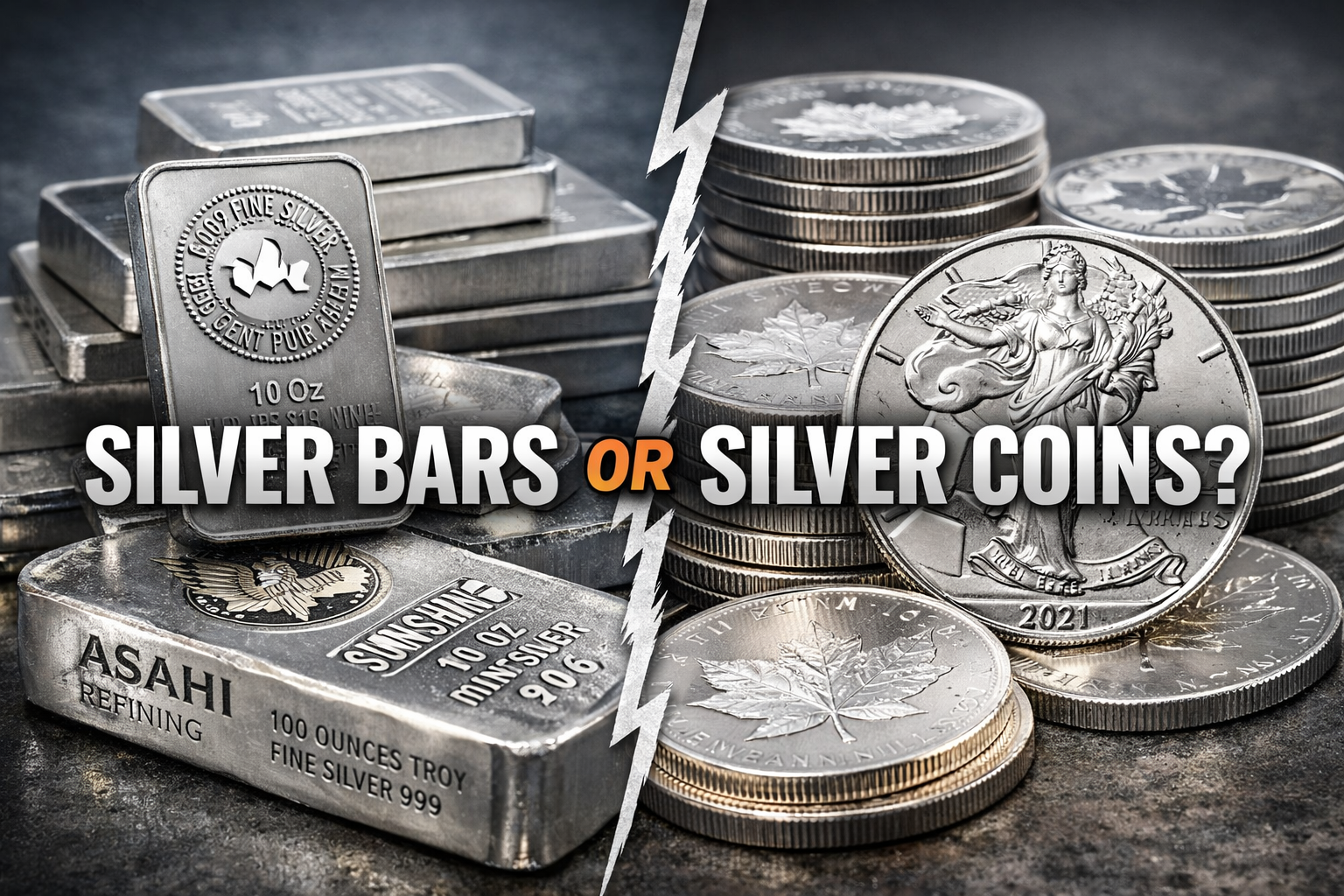
I get asked this all the time. Silver bars vs silver coins, which one should I buy? And honestly, the answer is not complicated. But people overthink it because there is a lot of noise out there, and most of it comes from sites that just want you to click “add to cart” without understanding what you are actually buying. So let me break down the silver bars vs silver coins debate the way I would explain it to someone standing in front of me.
First, What Are We Actually Comparing?
A silver bar is bullion. Pure and simple. It comes in standard weights. 1 oz, 10 oz, 1 kg, 100 oz. It is produced by private mints or refineries. Sunshine Minting, Silvertowne, Asahi, Royal Canadian Mint. The value is based on weight and purity. That is it.
A silver coin is also bullion, but it is struck by a government mint. The Canadian Silver Maple Leaf comes from the Royal Canadian Mint. The American Silver Eagle comes from the United States Mint. Because a sovereign government backs the coin, it carries legal tender status. You would never spend a Maple Leaf at Tim Hortons, but that government stamp carries real weight when it comes time to sell.
Silver Bars vs Silver Coins: The Premium Difference
Everything in physical silver costs more than spot. That markup is the premium. Minting, distribution, dealer margin. It all gets baked in. And this is where bars and coins start to separate.
Bars are cheaper per ounce. Period. A 10 oz RCM bar will cost you less per ounce than buying ten individual 1 oz silver coins. Go up to a 100 oz bar and the premium drops even further. If your entire goal is to stack as many ounces as possible for the least amount of money, bars are the obvious play.
Coins cost more. The designs, the security features, the government minting process. All of that adds up. A 1 oz Maple Leaf will always run you more than a 1 oz generic bar.
But here is the thing people miss. Premium is not just a cost. It is also part of your resale value. And that changes the math.
What Happens When You Go to Sell
This is the part that matters more than most people realize. I wrote about it in detail in my post about when to sell your silver. The short version is you are not selling “silver.” You are selling a specific product, to a specific buyer, on a specific day. And the product you hold makes a massive difference in what you actually get back.
Government coins are recognized everywhere. A Maple Leaf or an Eagle, any dealer on the planet will buy it from you instantly. The bid-ask spread is tighter because the market for these coins is deep and liquid.
Bars from reputable mints like RCM, Sunshine, and Asahi also resell easily. But generic bars from no-name mints? That is where it gets messier. Some dealers will want to test them. Some will offer you less because the demand for that specific bar is thin. I have seen it happen plenty of times.
So yes, you save on the way in with bars. But you might give some of that back on the way out if you are not buying from the right mints.
Security Features: Where Silver Coins Pull Ahead
Counterfeits exist. Anyone telling you otherwise is not paying attention. And this is one area where coins just flat out win.
The Maple Leaf has micro-engraved laser marks, radial lines, a privy mark that changes every year. These features are borderline impossible to fake well. The American Eagle has its own anti-counterfeiting tech built into the design. When you hold one of these coins, you know what you have. And more importantly, so does the person buying it from you.
Bars sometimes come with serial numbers or assay cards, which helps. But a generic round or bar with no identifying features? You are relying on weight and dimensions alone. That is a weaker position to be in. I have talked about purity and grading before. Understanding what you own and how to verify it is not optional if you are serious about this.
The Storage Question
Look, this sounds boring but it comes up constantly. If you are accumulating serious weight, bars stack better. They are flat, uniform, and compact. A few 100 oz bars in a safe holds a lot of value in a small space.
Coins in tubes and monster boxes eat up room fast. A 500 oz monster box of Maple Leafs is heavy and takes up real estate. For smaller positions this does not matter at all. But once you are north of a few hundred ounces, you start thinking about it. We offer storage solutions for customers who do not want to deal with this at home.
When Silver Bars Make More Sense
When you want maximum ounces and you are not planning to sell anytime soon. That is the sweet spot for bars. You are buying for the long haul, you believe silver is heading higher, and you want as much exposure as possible without overpaying on premiums.
If you have been following the recent pullback and you see it as a buying opportunity, bars let you load up at a lower cost basis. Simple as that.
When Silver Coins Are the Better Call
When flexibility matters. Maybe you want the option to sell a few ounces here and there without liquidating your whole stack. Coins let you do that. Try selling half a 100 oz bar. You cannot.
Coins are also what I recommend to anyone just getting started with physical silver. The security, the brand recognition, the ease of resale. It removes a lot of the friction for a first-time buyer. Start with a tube of Maple Leafs. Get comfortable. Then decide if you want to add bars later.
And there is a collectibility angle that bars will never have. Certain coin years, certain limited releases, they can pick up numismatic value over time. Not something to bank on, but it is a real upside. We carry some of those in our silver collectables section if that interests you.
What About Silver Rounds?
Rounds get overlooked and they should not. They look like coins but they are privately minted, so no government backing and no legal tender status. Think of them as bars shaped like coins. The premiums sit right between bars and sovereign coins.
If you want the feel and portability of a coin without paying the full government mint premium, rounds are a solid middle ground. They are easy to store, easy to sell to other collectors, and the variety out there is honestly pretty impressive. A lot of our repeat buyers end up here eventually once they have their core position in coins and bars figured out.
What I Actually See People Doing
Most of our customers who have been at this for a while own both. And I think that is the smartest play.
They build a base in coins. Maple Leafs, Eagles, sometimes rounds. Then they stack bars on top to bring the average premium down. The coins handle the “I might need to sell some of this” scenario. The bars handle the “I want as much silver as I can get” scenario. Both purposes, one portfolio.
There is no rule that says you have to pick one. In fact, picking one is usually the less optimal move.
Silver Bars vs Silver Coins: The Bottom Line
Bars are cheaper per ounce. Coins are easier to sell and harder to fake. Rounds split the difference. The whole silver bars vs silver coins question really comes down to your budget, your timeline, and how much flexibility you need on the way out.
If you are just getting into physical silver, start with coins. If you are scaling up, mix in bars. You can browse our silver bars and silver coins to see what fits. And if you are still trying to figure out whether now is even the right time to buy, read this piece on what I am doing after the big silver drop first.


Leave a Reply