


Imagine a world where inflation works in your favour—where it doesn’t stem from reckless government spending or money printing, but from a strategic move that could lighten the burden of national debt while boosting economic stability. This is the bold vision unfolding under President Trump’s aggressive tariff policy, which imposes a minimum ten percent tariff on imports. Unlike traditional inflation triggers, this approach avoids expanding the money supply, offering a unique twist. Raising prices on foreign products without printing cash it encourages local spending, potentially driving nominal GDP growth faster than the debt-to-GDP ratio. This could be a game-changer for America, easing the weight of significant government debt and fostering a perception of stability as countries worldwide take note.
However, this tariff-driven inflation isn’t without complexity. It’s the “best type of inflation” for governments and citizens alike, as it generates additional revenue to pay down debt rather than fuel further spending. Countries rich in commodities stand to benefit as their resources rise in value, while those reliant on imports may struggle. The global shift toward self-reliance could reshape trade dynamics, making this a pivotal moment for investors. Yet, with consumers still showing signs of depression—likely dampening inflationary pressure—it sets up a delicate balancing act. This consumer weakness might push the Federal Reserve to cut rates in the future, a move historically bullish for gold.
Recent data from the U.S. Bureau of Labor Statistics highlights this shift. The April 2025 inflation rate year-over-year dropped to 2.3%, below the previous 2.4% and the consensus 2.4%, down from 3.0% in January 2025. This trend, reflected in the bar chart below, suggests a cooling inflation environment despite tariff pressures.

The Tariff-Driven Gold Rush
Trump’s tariff push has injected volatility into global markets, unsettling equities and currencies. Investors, fearing trade wars and economic disruption, have flocked to gold as a safe haven, propelling prices upward in recent months. Merkur views this rally as a reaction to uncertainty. “Tariffs create uncertainty, and uncertainty fuels gold’s appeal,” he explains. “But markets are forward-looking. They don’t wait for policy changes to take effect—they move on anticipation.” Yet, with inflation easing to 2.3% in April, gold’s safe-haven demand may weaken.
A Critical Inflection Point
Looking ahead, Merkur sees a pivotal moment on the horizon. He predicts that Trump, despite his hardline stance, will eventually pivot toward negotiation, striking deals to reduce tariffs and promote freer global trade. Such a move, Merkur argues, would benefit the United States by fostering economic stability and strengthening international partnerships. As these negotiations progress, markets are likely to surge in anticipation of renewed stability.
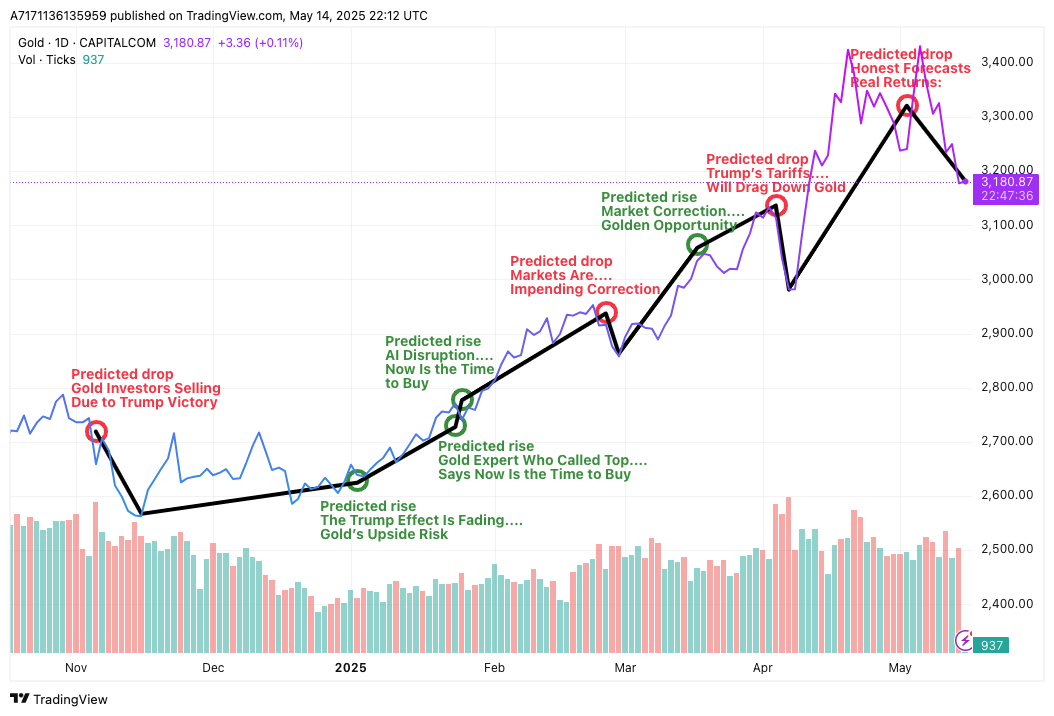
This shift, however, could spell a pause for gold’s current rally. As investor confidence in equities and riskier assets grows, the safe-haven allure of gold may wane, leading to a consolidation in gold prices. “When markets perceive stability, the fear premium that drives gold demand tends to fade,” Merkur notes. As Merkur stated in a previous article, Honest Forecasts, Real Returns: An Unconventional Path to Financial Influence (May 2, 2025), “This shift will cause the current gold market rally to consolidate or slightly dip as investors perceive stability in the markets, reducing gold’s safe-haven appeal.” However he maintains that “While we’re likely to see a pullback, it won’t be a collapse.”

Why Gold Won’t Crash
Despite the anticipated dip, Merkur remains optimistic about gold’s long-term prospects. He believes the gold’s fundamentals remain strong, supported by persistent geopolitical tensions, central bank buying, and inflationary pressures. “Gold isn’t going anywhere,” he asserts. “This consolidation will be a healthy correction, setting the stage for the next leg of the rally which will resume later in 2025.”
Merkur’s confidence stems from his deep understanding of market dynamics and his track record of accurately forecasting gold’s movements. Unlike those who view gold as a one-way bet, he emphasizes the importance of timing and context. “Gold is a powerful asset, but it’s not immune to market cycles,” he says. “Smart investors know when to hold, when to buy, and when to wait.” His track record, detailed in the graph below, underscores his reliability in navigating market cycles.
Positioning for the Future
For investors, this is a nuanced moment. The current gold rally offers opportunities, but caution is key as trade talks evolve. With consumer weakness and potential rate cuts in play, gold could rebound strongly. Merkur recommends gradually building positions through cost-averaging—a strategy where you invest a fixed amount regularly, regardless of price fluctuations, to reduce the impact of volatility and lower your average purchase cost over time. “Keep an eye on trade talks and market sentiment,” he advises. “If equities surge on optimism, consider trimming gold positions to lock in gains. But don’t abandon gold entirely—its next rally is just around the corner.”
At Gold Silver Mart Canada, we’re dedicated to equipping investors with clear insights. Whether you’re a veteran or a newcomer, our platform provides the tools to make informed decisions. Ready to take charge? Click to buy gold or to buy silver bullion products and stay ahead of the market’s next move.


Leave a Reply