


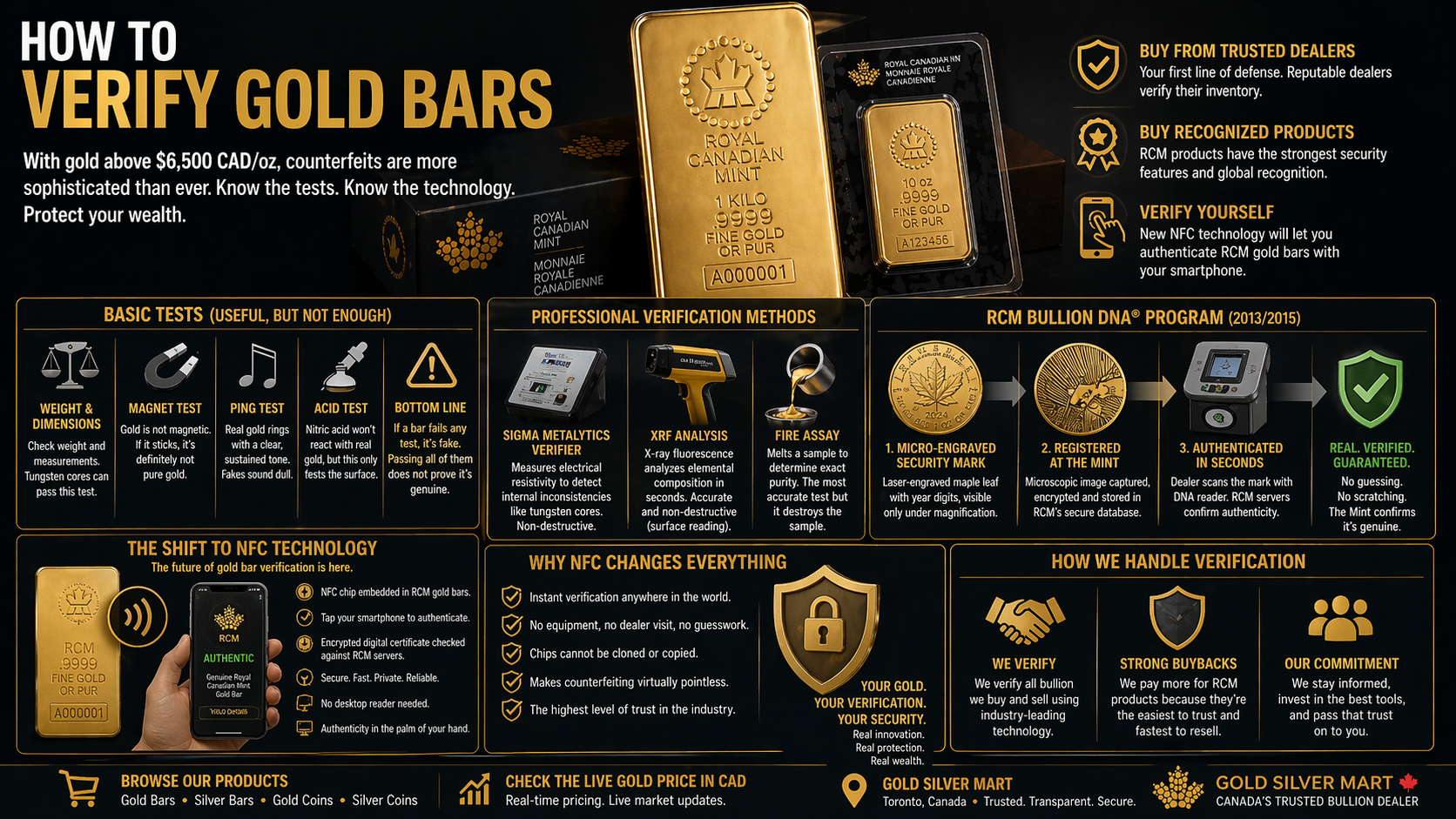
With gold above $6,500 CAD per ounce, the incentive to fake a bar has never been higher. Tungsten cores with gold shells, thick plating over base metals, cloned serial numbers, counterfeit assay cards. The fakes are getting better and some of them are good enough to fool basic tests. If you own gold or you are thinking about buying some, knowing how to verify gold bars is not optional. Here is everything we know, from the simplest checks to technology that is about to change the entire industry.
Basic Ways to Verify Gold Bars
There are a handful of tests that have been around forever. They are worth knowing but you need to understand their limits.
The weight and dimensions check is the most common. Gold has a density of 19.3 grams per cubic centimetre. A 1 oz bar should weigh exactly 31.1035 grams. Weigh it on a precision scale and measure it with calipers. If the numbers are off from the manufacturer’s specs, something is wrong. The problem is that tungsten sits at 19.25 density, almost identical to gold. A tungsten core with a gold shell passes a basic weight test and that is exactly what sophisticated counterfeiters use.
The magnet test is quick but limited. Gold is not magnetic so if a strong magnet sticks, the bar is fake. But copper, tungsten, and plenty of other non-magnetic metals are also not gold. Passing the magnet test proves nothing. The ping test, where you tap the bar and listen for a clear sustained ring versus a dull thud, takes a trained ear and is not something you should stake thousands of dollars on. And the acid test, where you scratch the surface and apply nitric acid, damages the bar and only checks the outer layer. A well-plated fake passes it because the surface is real gold.
If a bar fails any of these, you have a problem. But passing all of them does not mean the bar is real. These tests are part of knowing how to verify gold bars but they are the starting point, not the finish line.
Professional Equipment
Dealers and serious investors use technology that goes deeper. The Sigma Metalytics Precious Metal Verifier measures electrical resistivity through the entire bar using electromagnetic waves. Different metals have different resistivity profiles so it can detect a tungsten core that surface tests miss. It works through packaging and assay cards without touching the metal. XRF analysis, X-ray fluorescence, is the professional standard. It shoots X-rays at the bar and reads the secondary energy signatures to identify the exact elemental composition in seconds. Non-destructive and fast. The limitation is that it only reads the surface layer so experienced operators take readings from multiple points.
Fire assay is the definitive test. You take a sample, melt it, separate the gold, and weigh it. Absolute certainty about purity. But it destroys the sample so it is reserved for situations where nothing else resolves the question.
Most retail investors will never use any of this equipment. But knowing it exists matters because when you buy from a dealer who has already run these checks, you are benefiting from that verification without needing the tools yourself.
What the Royal Canadian Mint Did Differently
Everyone else in the industry approached verification as something the buyer or dealer does after the fact. Test the bar. Check the weight. Run it through a machine. The Royal Canadian Mint did the opposite. They built authentication into the product during manufacturing.
Starting in 2013 on Gold Maple Leafs and 2015 on Silver Maple Leafs, every die used to strike coins is laser micro-engraved with a security mark. A textured maple leaf with the production year inside it, visible only under magnification. The engraving is done on the dies using proprietary laser technology. During production the Mint captures a microscopic image of each die’s mark, encrypts it, and stores it in a secure database. Each die’s mark is unique at the microscopic level. Like a fingerprint.
Their Bullion DNA program gave authorized dealers a countertop reader. Place a coin in the device. It photographs the mark and sends the image to the RCM’s servers. The server decodes the encrypted signature and searches for a match in the production database. If it matches, genuine. Seconds. No acid, no scratching, no guessing. The Mint itself confirms the product.
The DNA program changed how to verify gold bars from something you do after the fact to something built into the product from the moment it is struck. The radial lines on Maple Leaf coins add another layer. Precision-machined grooves radiating from the center that create a shimmering diffraction pattern when tilted under light. Specific to each coin design and extremely difficult to replicate. The bars carry the same micro-engraved marks plus individual serial numbers and tamper-evident assay packaging.
Nobody else did anything close to this. The US Mint did not. Perth Mint did not. PAMP Suisse did not. The RCM invested in building a verification infrastructure around their products for over a decade. That infrastructure is why their products command the buyback premiums they do. When we buy gold back from customers, we pay more for RCM products than anything else because the security features make them the fastest to authenticate and the easiest to resell.
But the DNA program had a limitation. You needed the desktop reader. Only dealers who invested in the hardware could run the electronic verification. The average investor buying a Gold Maple Leaf could not do it themselves.
The Future of How to Verify Gold Bars: NFC
The Royal Canadian Mint told us on the phone that they are phasing out the Bullion DNA desktop reader and moving to NFC.
NFC is Near Field Communication. Same technology you use when you tap your phone to pay at a store. The RCM is embedding NFC chips into their gold bars. You hold your smartphone near the bar, tap it, and the chip communicates with an app connected to the Mint’s authentication servers. Your phone confirms whether the bar is genuine.
Each chip has a unique encrypted digital certificate. It cannot be copied or cloned the way a serial number or QR code can. If someone put a cloned chip on a fake bar, the encrypted signature would not match what the Mint has on file. The fake fails verification instantly on your phone.
A company called MintID has been doing NFC authentication with Valcambi Suisse bars for a few years already. But MintID is a private company working with a private mint. The Royal Canadian Mint is a sovereign government Crown corporation with over a century of reputation. The trust level is not in the same category.
What changes is who can verify. Right now if you buy gold from any source other than a dealer you trust, you have to wonder. Is it real. Should I get it tested. Should I take it somewhere with a Sigma or XRF. With NFC-equipped RCM bars you pull out your phone, tap the bar, and you know. Anywhere. No equipment. No expertise. No appointment. Counterfeiting RCM products becomes functionally pointless because anyone can catch a fake in seconds with a device they already own.
This is information we got directly from the RCM through our relationship with them. As far as we know, no other dealer has written about this transition publicly. When these bars hit the market, how to verify gold bars becomes as simple as pulling out your phone..
Why This Matters Right Now
We wrote about why physical gold is the only asset AI cannot hack. The core argument is that physical bullion has no digital attack surface. No login, no password, no server. The NFC development adds something on top of that. Your physical gold can now prove it is real without leaving the physical world. The verification happens through a chip embedded in the metal, confirmed by the Mint’s own servers. The gold carries its own proof of authenticity.
In a world dealing with AI deepfakes, quantum computing threats, and paper gold markets trading at 100:1 ratios over physical supply, the ability to instantly verify that your gold is real and that it came from a sovereign mint is something no other asset class can offer. Not stocks, not bonds, not crypto, not ETFs. Physical gold with NFC verification from a government mint.
We have a good relationship with the Royal Canadian Mint. We talk to them frequently and they keep us informed on what is coming. That is how we knew about this before it was public. If you want to understand the broader case for why we think now is a good time to buy gold, that article covers the macro. If you want to know why we recommend RCM products specifically, our RCM gold bars post covers that.
Browse our gold bars and silver bars. Check the live gold price in CAD. When NFC-equipped RCM bars become available, we will carry them.


Leave a Reply