


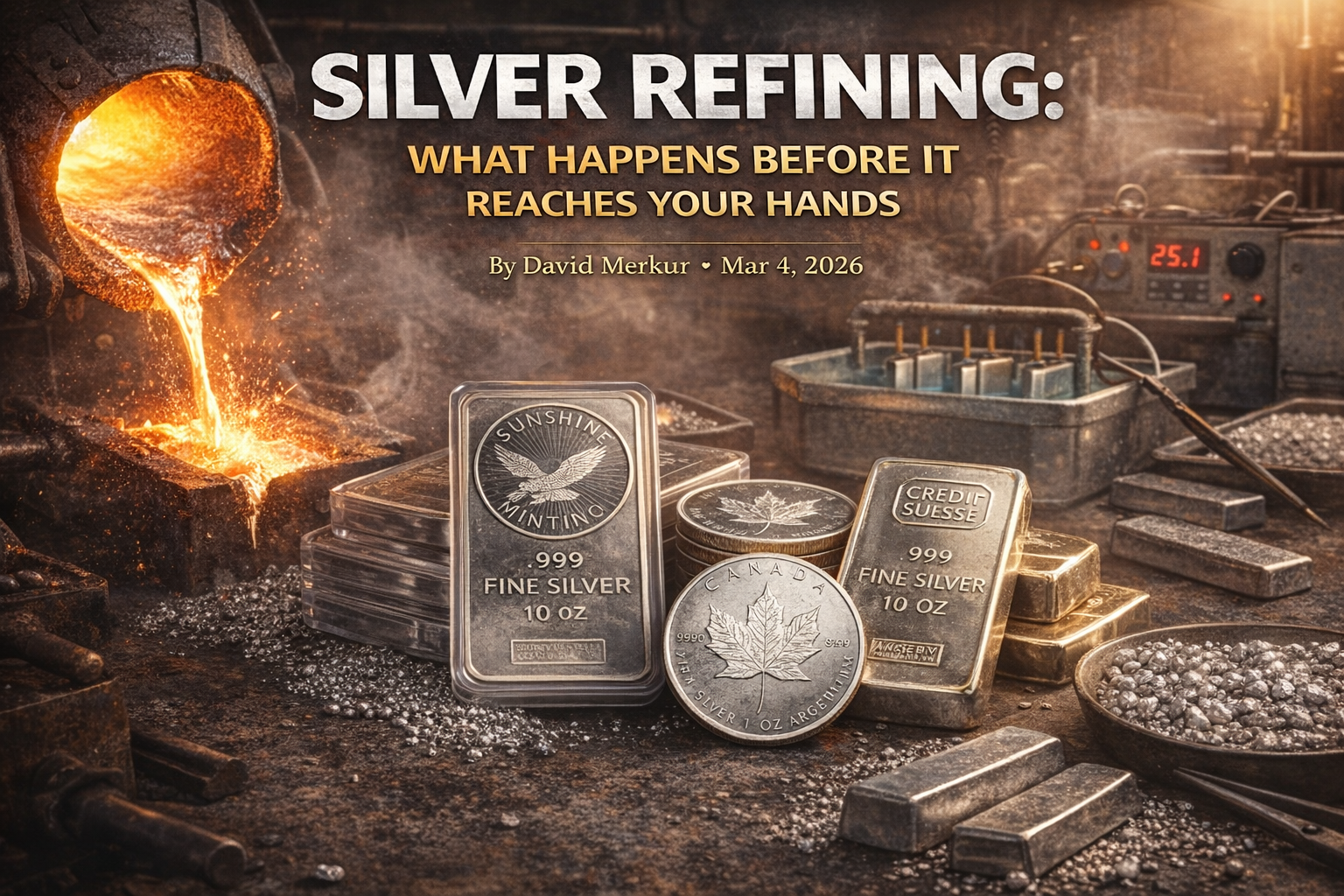
Most people who buy silver never think about what it took to get that bar or coin into their hands. And honestly, you do not need to know the chemistry to be a smart buyer. But understanding the basics of silver refining gives you a much clearer picture of why purity levels exist, why some products cost more than others, and why the supply side of silver is tighter than most people realize.
Where Silver Comes From
Silver is rarely mined on its own. About 70 to 75 percent of the world’s silver supply comes as a byproduct of mining other metals. Copper, lead, zinc, and gold mining operations all produce silver as a secondary output. Only about a quarter of global silver comes from dedicated silver mines.
This matters because it means silver supply does not respond to silver prices the way you might expect. If the price of silver doubles, copper miners do not suddenly produce twice as much silver. Their output is driven by copper demand, not silver. The silver just comes along for the ride. So when demand for refined silver increases, the supply side cannot simply ramp up to meet it. That constraint is baked into how silver is produced.
What Silver Refining Actually Is
When silver comes out of a mine it is not pure. It is mixed with other metals and impurities. Refining is the process of removing those impurities until you are left with silver at a target purity level.
There are a few ways to do this. The oldest is heat-based. Pyrometallurgy involves melting the raw material and using chemical reactions to separate the silver from everything else. Cupellation has been around for thousands of years and is still part of the process in some operations. But the method that gets silver to .999 purity, which is the commercial standard, is electrochemical. Silver gets dissolved into a solution and an electric current pulls pure silver out of it, depositing it onto a cathode while the impurities stay behind. The Moebius and Balbach processes are the two main versions of this and they are what most refiners use today.
Getting to .999 is where most operations stop. That is the standard you see on the majority of silver bars on the market. It qualifies as investment grade, meets the GST/HST exemption threshold in Canada, and for the vast majority of uses it is more than pure enough.
What It Takes to Get to .9999
Going from .999 to .9999 sounds like a tiny step but it requires additional refining that most operations do not bother with. Techniques like fractional crystallization, zone refining, and additional electrolytic passes are used to strip out that last 0.09 percent of impurities. It takes more time, more precision, and more specialized equipment.
The Royal Canadian Mint is one of the few mints in the world that refines silver to .9999 for its standard bullion production. The Silver Maple Leaf has been struck at .9999 fine since 1988. Most other sovereign mints, including the US Mint with its American Silver Eagle, stop at .999. That extra nine is not just a number. It represents a higher standard of refining capability and it is part of what makes the Maple Leaf the product it is. We went deeper on this in our Silver Maple Leaf guide.
The practical difference for a bullion buyer is minimal in terms of melt value. Both .999 and .9999 products contain one troy ounce of pure silver per ounce stated. But the .9999 standard signals something about the quality of the production and it does factor into the premium and resale dynamics. We covered that in detail in our post on precious metal purity.
Where Refined Silver Actually Goes
This is the part that most bullion sites never talk about and it is arguably the most important part of the silver refining story.
Investment bullion only accounts for a portion of total silver demand. The majority goes to industry. Electronics manufacturing is the biggest consumer by far. Silver has the highest electrical conductivity of any metal and it goes into printed circuit boards, semiconductors, contacts, switches, and increasingly into the data center infrastructure being built out for AI. That demand has been growing steadily and there is no sign of it slowing down because there is no real substitute for silver in applications where maximum conductivity matters.
Solar is the one making headlines though. Silver paste is a critical component in photovoltaic cells and every panel produced uses roughly 20 grams of the stuff. In 2024 the solar industry consumed close to 200 million ounces of silver, nearly 20 percent of total global demand from that one sector alone. That number has more than tripled since 2015. Medical devices, EVs, water purification, 5G — silver shows up across all of them because its physical properties are genuinely difficult to replace.
The point is that refined silver is not just sitting around waiting to become coins and bars. It is being pulled in a lot of directions at once.
Bullion and Industry Do Not Use the Same Product
People sometimes assume that because certain industries need high purity silver, a .9999 Maple Leaf could just be melted down and fed into a production line. It does not work that way.
A solar panel manufacturer needs silver in a very specific form. Silver paste with controlled particle sizes and chemical properties designed for their equipment. The physical form matters as much as the purity. Even if you handed them a .9999 coin they would need to dissolve it, reprocess it into powder with the right specifications, and that adds cost and steps that make zero sense when they can buy exactly what they need directly from a refiner. So no, factories are not buying Maple Leafs in a shortage. They have their own supply contracts and their own product specifications.
But here is what connects bullion buyers and industrial users. Both are drawing from the same finite pool of refined silver upstream. A refiner producing silver powder for an electronics company and a mint striking Maple Leafs are making different end products but they are starting from the same material. And when demand from one side surges, the other side feels it.
Why This Matters If You Own Silver
The mines produce roughly a billion ounces a year. Industrial demand, investment demand, and jewelry demand all compete for that output. For several years now total demand has exceeded total supply.
When industrial demand surges, refiners allocate more of their output toward those contracts. Industrial buyers tend to be higher volume and their orders are locked in ahead of time. That leaves less refined silver available for mints to turn into the bars and coins you and other investors are buying. That is when premiums spike, delivery times stretch, and products go out of stock.
If you were buying silver during 2020 and 2021 you saw this firsthand. Product was hard to get. Premiums went through the roof. Not because silver disappeared from the earth. Because the refined silver that would normally flow into bullion production was getting pulled toward industrial buyers who had contracts and volume on their side. The mints could not get enough supply to keep up with retail demand at the same time.
This is part of why we have been writing about where we think we are in the broader metals cycle. Silver is not just a monetary metal. It is a critical industrial input with growing demand and a supply chain that cannot scale the way people assume it can. The silver in your safe and the silver in a solar panel came from the same ground and went through the same refining infrastructure. They ended up as different products but they competed for the same supply on the way there.
What This Means for What You Buy
Understanding silver refining does not change the products we recommend. Silver bars from Sunshine Minting, Asahi, and others are refined to .999. Investment grade, tax exempt in Canada, lowest premium per ounce. That is the efficient way to stack weight and there is nothing wrong with .999 for that purpose.
The Maple Leaf at .9999 costs more per ounce but you are paying for additional refining, government backing, security features, and a resale market that is deeper than anything else out there. Whether the extra premium is worth it depends on what matters to you. For most of our customers the answer is to own both, which is what we generally suggest. Start with coins for the liquidity and recognition, add bars to bring your average cost down over time.
Every product we carry has been through a refining process that took raw material from the ground and turned it into something with verified weight and purity. That process is not free and it is not unlimited. The more you understand about where silver comes from and how many directions it gets pulled in, the more you understand why physical silver holds the value it does.
Browse our silver coins and silver bars to see what is available. And if you want to understand more about purity, resale, and how to verify what you own, start with our precious metal purity guide.


Leave a Reply